Meet the MAI family: seven in-house models that could change how Microsoft competes in the AI race and reduce its dependence on OpenAI.
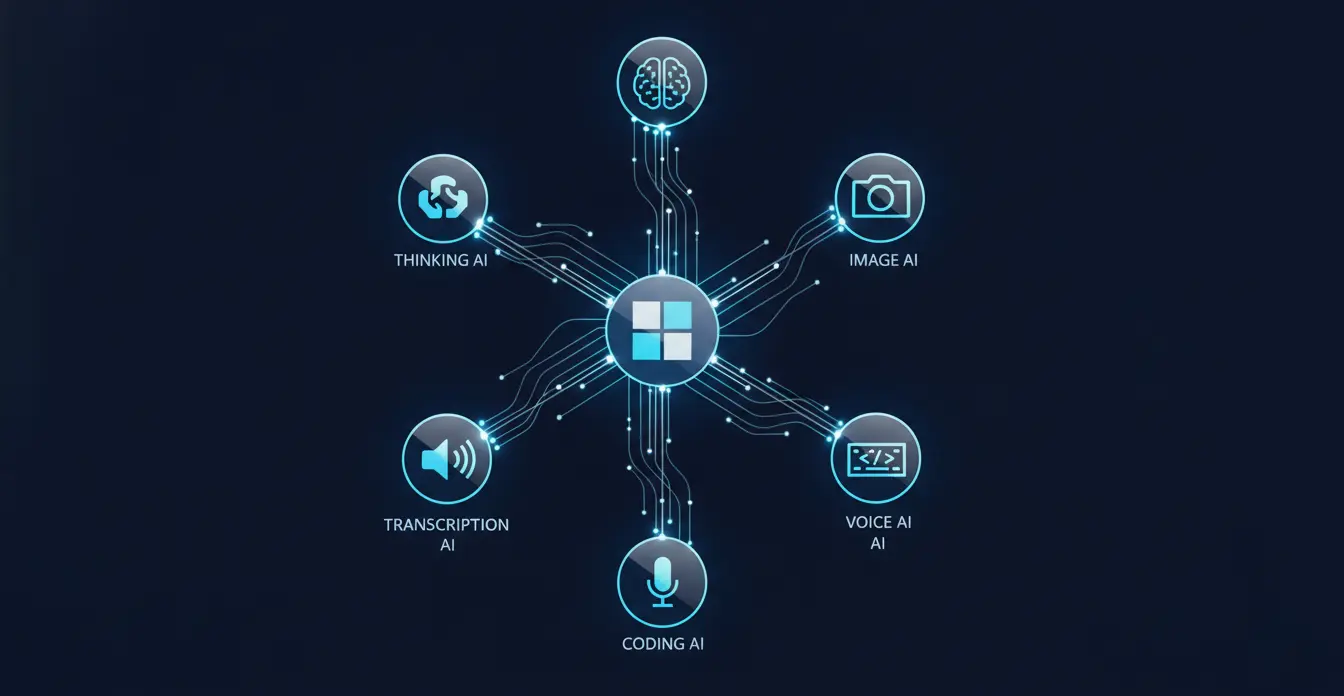
For years, Microsoft’s AI story has been largely about its partnership with OpenAI. But that’s quietly changing. At a recent milestone event, Microsoft officially introduced the MAI model family a suite of seven AI models built entirely in-house, designed not just to automate tasks, but to push toward what the company calls “humanist super intelligence.” That’s a bold phrase. Let’s unpack what it actually means and why it matters.
What exactly is the MAI model family?
The MAI family isn’t one model, it’s seven, each built for a specific job. Microsoft’s core philosophy here is interesting: they want AI that genuinely prioritizes human progress and well-being, not just efficiency. Whether that philosophy shows up in practice remains to be seen, but the lineup itself is impressive.
Thinking model
The reasoning workhorse built for complex, long-context problems that need real depth.
Image model
Create, expand, and edit visual content no third-party image tools required.
Transcription model
World-class speech capture and understanding across real-world audio.
Voice model
Natural-sounding speech generation across multiple languages.
Coding model
Tuned specifically for GitHub Copilot fast, efficient, and developer-focused.
That’s five named models so far, with two more rounding out the full family of seven. The breadth here is the point Microsoft is building a complete stack, covering text, vision, voice, code, and reasoning under one roof.
Frontier tuning: giving you the controls back
One of the quieter but genuinely significant announcements was Microsoft’s Frontier Tuning process. In plain terms, it’s about giving enterprise customers more control over how the models behave outputs, style, constraints, domain-specific behavior. If you’ve ever felt like AI tools are a black box you can’t steer, this is Microsoft’s answer to that frustration.
Think of Frontier Tuning as the difference between buying a car and leasing one. With leased AI, you get what you’re given. Frontier Tuning hands you the wheel at least a little more than before.
The bigger picture: independence from OpenAI
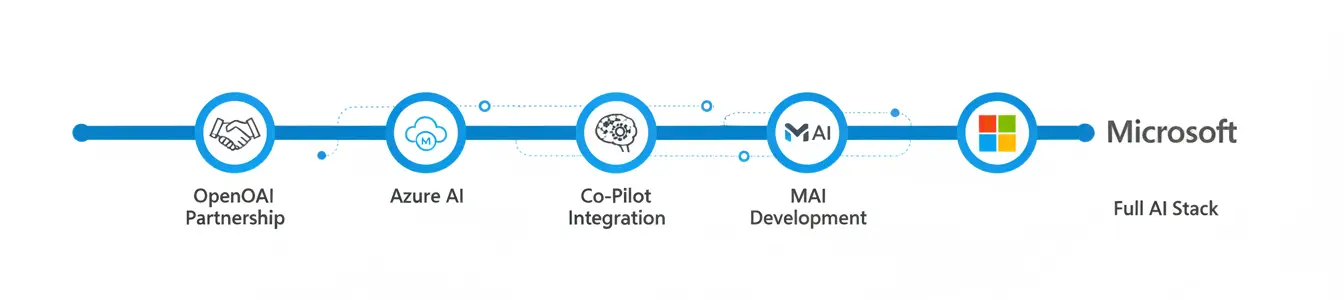
Here’s the strategic layer that most coverage glosses over. Microsoft’s partnership with OpenAI has been enormously valuable, but it’s also a dependency. Every enterprise customer using Azure AI or GitHub Copilot has, to some degree, been building on someone else’s foundation.
The MAI family changes that. By building a fully multimodal, integrated ecosystem in-house, spanning reasoning, image, voice, transcription, and code, Microsoft gains the ability to offer enterprise-grade AI performance without routing everything through a third party. For large organizations with compliance requirements, data sovereignty concerns, or just a preference for stable, predictable pricing, this is a meaningful shift.
It also puts Microsoft in a stronger negotiating position with OpenAI for the future, though neither company would phrase it that way publicly.
Frequently Asked Questions (FAQs)
It’s Microsoft’s framing for AI that is designed with human outcomes as the primary goal not just productivity gains or cost savings. In practice, it means the MAI models are supposed to be built with guardrails, transparency, and user empowerment in mind. Whether that translates into measurable differences in how the models behave versus competitors’ offerings remains to be independently tested. For now, it’s a philosophical commitment that shapes the development principles more than any single feature.
Not exactly at least not publicly. Microsoft still has a significant investment in and partnership with OpenAI, and OpenAI models continue to power several Microsoft products. What the MAI family signals is that Microsoft is diversifying its AI capabilities so it’s no longer entirely dependent on that relationship. Think of it less as a breakup and more as building your own backup generator you still have the main power supply, but you’re no longer vulnerable if it goes down. For enterprise customers, this also means more options and potentially more competitive pricing over time.
The MAI coding model is specifically tuned for GitHub Copilot’s use cases code completion, debugging, documentation, and developer workflows rather than being a general-purpose model that happens to handle code. This kind of task-specific tuning typically results in faster responses, better context awareness within a codebase, and fewer hallucinations when suggesting code. For developers using Copilot daily, the most noticeable improvement should be in how well it understands project-specific context and produces suggestions that actually fit the surrounding code.
Frontier Tuning is Microsoft’s process for giving enterprise customers greater control over how the MAI models behave in their specific context. Rather than accepting a one-size-fits-all model output, organizations can tune behavior things like response style, domain focus, content boundaries, and output formatting to fit their workflows. It’s primarily aimed at large enterprises with specific compliance, regulatory, or branding requirements that off-the-shelf AI doesn’t meet well. If you’re a small business or individual user, it’s less immediately relevant but it signals the direction Microsoft is heading for its Azure AI platform.
Microsoft has announced the MAI model family but has not confirmed a full public release schedule for all seven models at the time of writing. Some capabilities particularly those tied to GitHub Copilot and Azure are expected to roll out to enterprise customers first, with broader availability following. Microsoft tends to phase releases through its enterprise tier before opening them to individual users. Keep an eye on the Microsoft AI blog and Azure announcements for the latest timelines. If you’re an Azure or Microsoft 365 enterprise customer, it’s worth checking with your account team for early access programs.
Microsoft’s MAI announcement is one of those moves that looks incremental on the surface but signals something much bigger underneath. Building seven in-house AI models across reasoning, vision, voice, transcription, and code isn’t a side project it’s a strategic repositioning. Whether the “humanist super intelligence” philosophy translates into genuinely better, safer AI is a question worth watching. But for enterprises relying on Microsoft’s ecosystem, having a more integrated, controllable, and independent AI stack is already a meaningful win.
